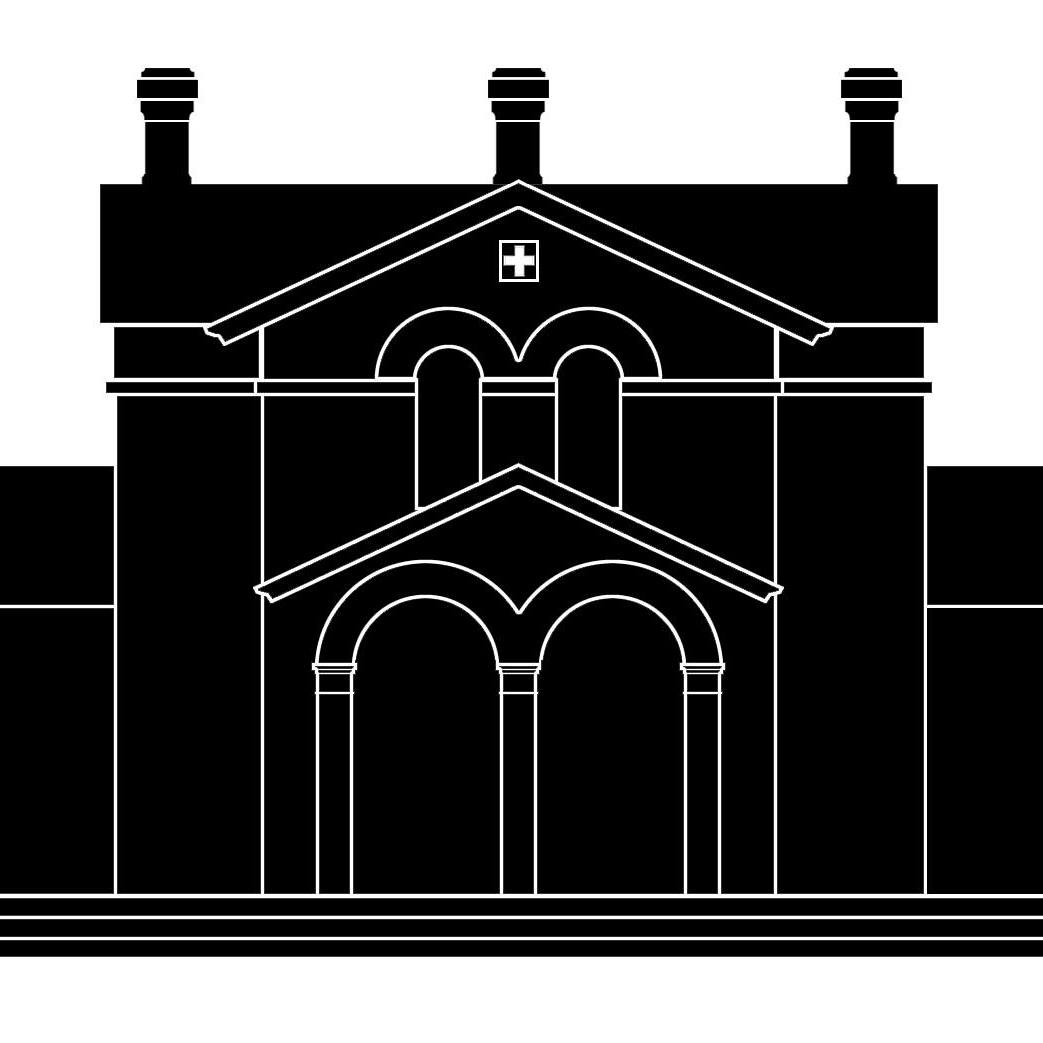

4 Powlett Street, Kilmore. Built 1863 to 1864.
Architect: J J Clark. Cost £3673.
Fire destroyed Kilmore’s first wooden court house in 1862 and this less flammable replacement was completed in 1864. The building’s cost was substantial, but the site came almost free. The widow of the publican of the Kilmore Hotel virtually donated it as she owned other property nearby and was anxious to maintain the town centre where it was.
Inspired by the Italian Renaissance, the court house is in basalt rubble laid in courses. Bluestone pillars and pilasters support the triple arches of the entrance porch. Windows over the porch admit light to a steep public gallery on the upper level with its three cramped and uncomfortable wooden benches. Uniquely among surviving court houses, a lock-up and a lock-up keeper’s quarters are actually provided within the building.
In November 1905, the court house was the scene of the so-called Kilmore Flogging Case. Three youths had molested a young woman and one had put his hand up her skirt. Police Magistrate Read Murphy was incensed and called on the youths’ fathers to give their sons a flogging. A stirrup leather was produced and the magistrate knotted it ready for use. The first father took his son into the jury room and Murphy ordered a policeman to follow as a witness.
When the policeman refused, the magistrate himself supervised while the boy’s trousers were removed and the father flogged him in a “very thorough manner”. The second father then followed suit, while the third asked permission to delegate the job to a hefty bystander who had volunteered his services. The floggings over, Murphy sentenced all three youths to be imprisoned for 48 hours, directing they be separated and fed only bread and water.
Questions were raised in Parliament and Murphy was asked to explain his actions. He replied that he’d been congratulated by an Anglican bishop and commended by dozens of schoolmasters. He said similiar thrashings had cured larrikinism at Macarthur. The report was tabled and Parliament troubled itself no further with the affair.
Despite Kilmore’s litigious reputation, the County Court was discontinued in 1916 for lack of business. Petty Sessions, and later a Magistrates’ Court, sat until 1990. The court house is now a tourist information centre and museum.
Printed with permission from: “Historic Court houses of Victoria” by Michael Challinger P. 108
Published in 2001 by Palisade Press, 19 Georges Road, Ringwood, Vic. 3134.
The Kilmore Historical Society opened its research rooms at the former court house in April 2000. Our Society moved next door to the Old Kilmore Post Office in December 2020.


Leave a Reply
You must be logged in to post a comment.