

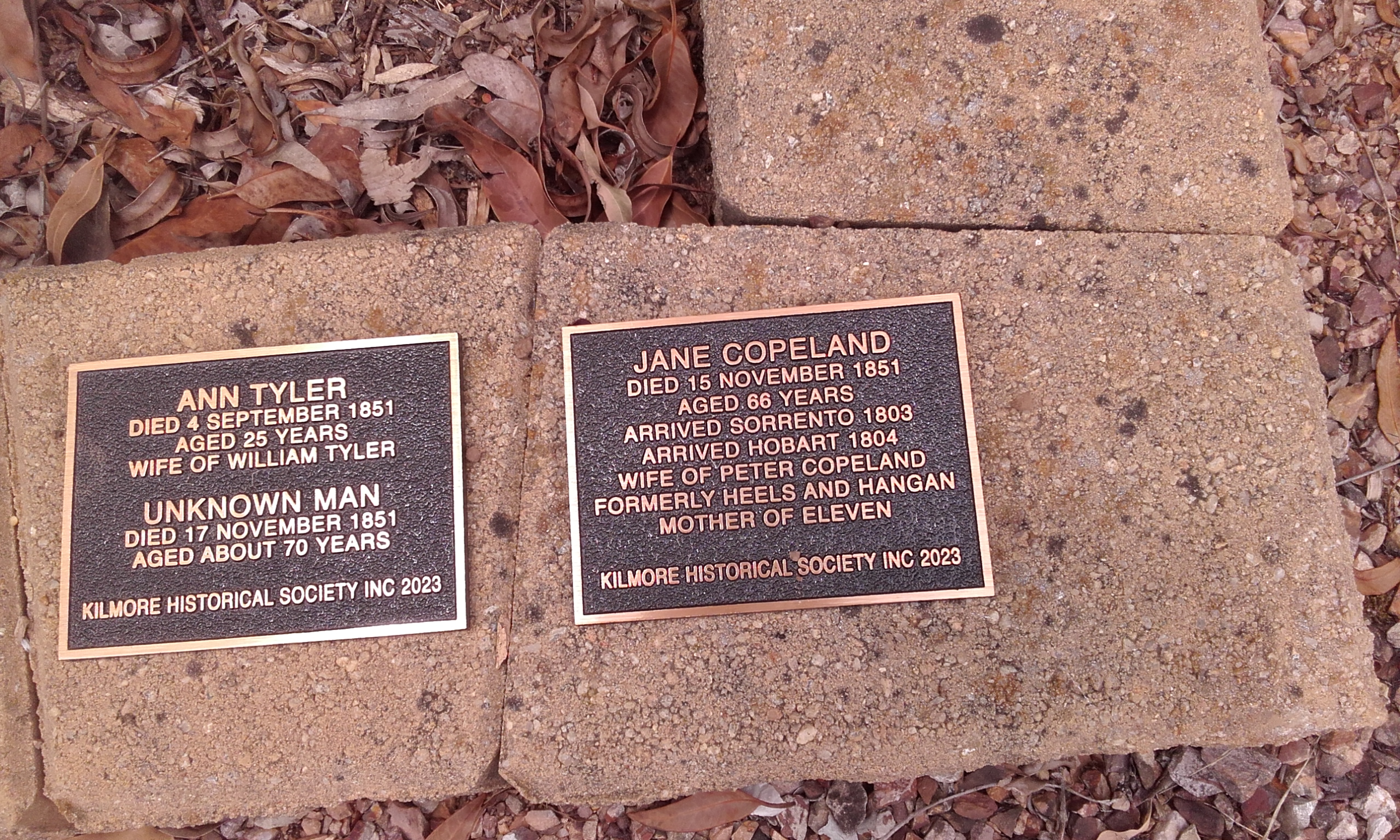
We have recently been contacted by a descendant of Jane Copeland to inquire if we are planning to order a brass plaque for her to place in the cemetery, as we have done with the first three burials.
The good news is that she will be commemorated by a plaque. She was the eighth person to be buried, so she is definitely ‘on the list’ and her plaque is likely to be in the next batch.
Update 11/2/25 – A plaque was erected for Jane Copeland in December 2023. It is pictured here.
We did present Jane in a Cemetery Tour last year, which covered the females of Kilmore and was organised for International Women’s Day. Her life was fascinating and eventful. As a result of this tour Barbara Wilson wrote an article for our newsletter, largely based on information provided by Travis Ibrahim, a descendant.
As we have now had contact with another descendant we have decided to republish that article here.
JANE COPELAND – AN EARLY PIONEER AT SORRENTO AND HOBARTOWN
At the International Womens’ Day walk at the Kilmore General Cemetery recently, Jane Copeland (formerly Heels and Hangan) was remembered as one of the earliest burials in the cemetery.
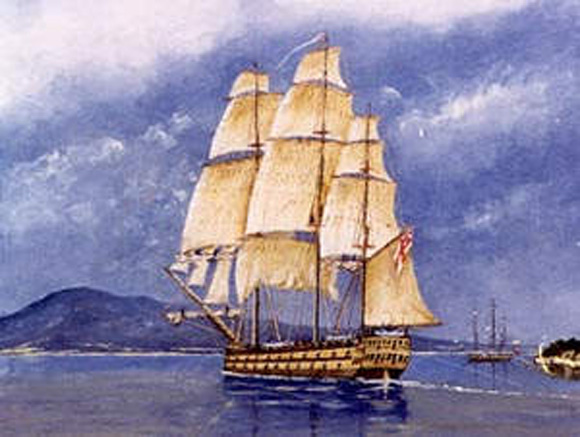
Still a teenage girl, Jane was married to John Heels, convicted of horse stealing and transported on the ‘Calcutta’. (pictured above) The fleet consisting of the ‘Calcutta’ and the “Ocean” was under the command of Colonel David Collins who had been made responsible for establishing a new settlement at Port Phillip to deter the French.
After a journey of 168 days the ‘Calcutta’ arrived in Port Phillip on 9th October 1803, the first Europeans to attempt a settlement on the south coast of Terra Australis. The settlement at Sullivan’s Bay, (modern day Sorrento) was a disaster with many deaths including that of John Heels on 3rd January 1804, one of 25 convicts to die. On 30th January 1804, the settlement was abandoned, and widow Jane along with the rest of the surviving settlers, were bound for a small settlement recently established at Risdon Cove, on the Derwent River, 4 miles north of current day Hobart Like Sullivan’s Bay, the site was deemed unsuitable by Collins, and on 20th February 1804 moved to a new site upriver named by Collins Sullivan Cove, but soon known as Hobart Town.
Jane was one of the few unmarried women in the fledgling colony. Convict John Hangan was assigned to her as her servant and on 30th July she married him. Between 1805 and 1816, seven children were born to the couple, 6 sons and 1 daughter. By 1805 they acquired a 50 acre land grant known as Hangan’s Point, today known as Pavilion Point and the site of Government House and the Botanical Gardens. Eleven year old John Hangan Jnr went missing in 1817 while searching for stray cattle; his skeleton was found nearly 12 months later. A further child was born in 1819 but died two months later.
In 1821 John was granted 50 acres of land at Tea Tree Brush, 15 miles north of Hobart, near Brighton. Then in February 1826 John Hangan died – and Jane was a widow for the second time. But worse was to follow – on 23 May 1828, Jane’s first born John Edward Hangan was hanged – a bushranger – and the first native-born youth in the colony to be executed.
In June 1827 Jane gave birth to another son, Peter Hannagan, no father listed on the baptism record, but likely to have been free settler Peter Copeland, who Jane married in Hobart Town on 3 August 1829. In November she gave birth to a daughter Mary Jane Copeland.
On 10th of June 1849, Jane & Peter Copeland arrived in Melbourne on the “Flying Fish”, a far cry from Jane’s original experience at Sorrento 46 years earlier. Three of her sons were already on the mainland and two in Kilmore.
Her time in Kilmore was short – on 15th November 1851, at the age of 66 years, Jane Copeland died and was buried here in the Kilmore cemetery on 17th November, most likely in the Old Church of England section as the service was conducted by the Rev. Singleton. No cause is given for her death. Interestingly Jane’s burial is only the eighth in the cemetery which opened in 1850, as shown on the Burial Register for the Parish of Bylands, County of Dalhousie, in the Colony of Victoria. Peter Copeland died and was buried in Kilmore in 1859.
What a remarkable woman and a remarkable life.


Leave a Reply
You must be logged in to post a comment.