

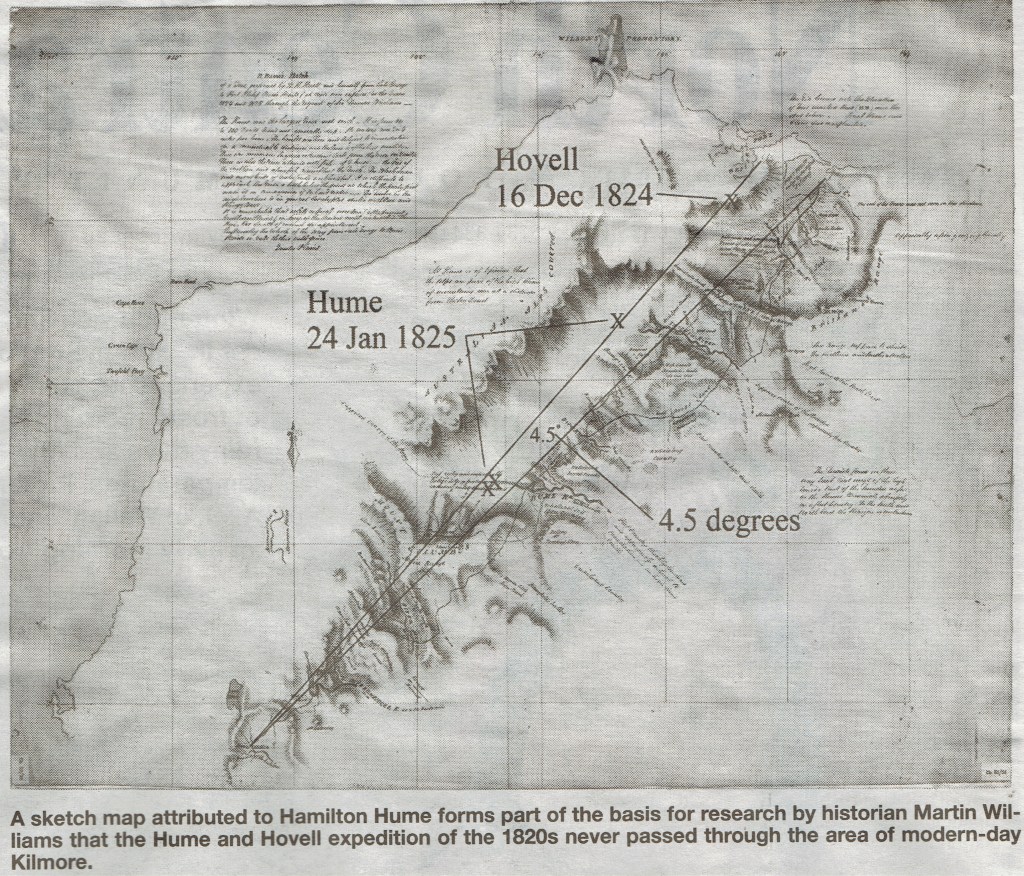
This Tuesday’s edition of the North Central Review (July 20, 2021) contained an article titled “History Dispute”. The substance of this item is that historian Martin Williams has published a peer-reviewed article in this month’s Victorian Historical Journal which concludes that Hume and Hovell’s 1824 expedition south from Sydney did not cross Monument Hill, and thus did not traverse the site of the present Monument.
The significance of this finding is that the submission for heritage listing of the Monument was based on the assumption that the site of the structure did form part of the route. Martin Williams has now applied for that heritage listing to be reviewed, and it is likely that the current listing will be voided as a result of his research.
This is not the place to go into his findings in detail. The current issue of the Victorian Heritage Journal is not available online, but his conclusions are based on an analysis of the explorer’s diaries and sketch maps.
His conclusion concurs with the findings of our own Grahame Thom, who analyzed the same material in an attempt to trace the route taken by the explorers some years ago, and concluded that the nearest they had come to Kilmore or Monument Hill on their outbound expedition was some eight kilometers to the East of the present Monument, where they had crossed the Sunday Creek and arrived at a point near the current Hume Highway.
What I find particularly interesting is the fact that the impression that Monument Hill formed part of Hume and Hovell’s route seems to have arisen after the erection of the Monument, and was not aired before.
The Argus for 11 October 1924 contains an article with the following text:
In connection with the forthcoming Hume-Hovell centenary, the committee formed at Kilmore is making good progress. A combined cairn, with spiral stair, will be built on the lookout which overlooks Mount Disappointment and the track taken by the exploring expedition 100 years ago. The cairn will be of blue stone, given for the work by the Kilmore Dairy Company. The stone formed a portion of the old Kilmore gaol.
This makes it fairly clear that even at the time of the erection of the Monument there was no claim being made that Hume and Hovell had actually traversed the Hill. The lookout on the top of the tower allowed visitors to see Mount Disappointment, which does appear to have been part of their trip, and this is quite a different claim to stating that Monument Hill was on their route.
There does not appear to be any actual threat to the existence of the Monument from a voiding of its heritage listing. Monument Hill remains a Council owned reserve, and it is unlikely that there would be any proposal to demolish it.
One interesting question is whether there would be any grounds for a relisting of the Monument which did not include the question of its forming part of Hume and Hovell’s route.
Kilmore’s Monument was erected in 1924 as part of the centenary of the Hume and Hovell expedition, and is a good reflection of the community enthusiasm and spirit of nation-building that prevailed after the close of the First World War.
Is it possible that the listing be amended to preserving the Monument as an example of the nation-building enthusiasm of Australia in the 1920’s ? I would personally feel that its significance as a statement of the enthusiasm over the role of Hume and Hovell can stand irrespective of the fact that the evidence suggests that the explorers did not traverse the actual site of the Hill.
 Kilmore Historical Society
Leave a Reply
You must be logged in to post a comment.